


Digital Ecosystem Optimization
Is your technology stack accelerating execution, or creating hidden friction?
Are Your Digital Investments Working as a System?
According to the 2023 Gartner CEO and Senior Business Executive Survey, 89% of boards consider digital initiatives critical to growth, yet fewer than half report achieving expected value from digital investments. Most enterprises don’t suffer from a lack of tools. They suffer from a lack of structural coherence. Complexity scales faster than coordination.

Platform Proliferation
Tools multiply faster than governance.

Integration Drift
Data flows fragment across systems.

Ownership Ambiguity
No single view of system accountability.
Why Digital Ecosystem Optimization Matters
Digital ecosystems expand faster than they mature. Platforms are added. Integrations multiply. Governance diffuses. Over time, teams adapt to system friction instead of resolving it. Optimization is not about replacing tools. It is about structuring how platforms, data, workflows, and governance operate as a coordinated enterprise system.

What Does Digital Ecosystem Maturity Look Like?
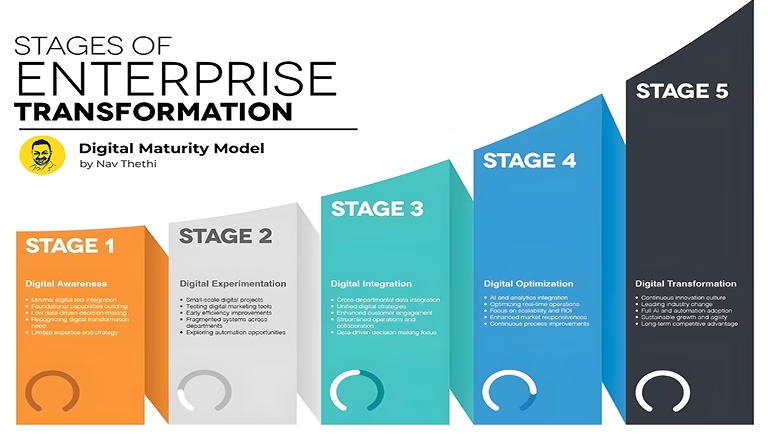
Digital ecosystems evolve through structural phases:

Phase 1 – Accumulate
Add platforms to solve immediate needs.


Phase 2 – Integrate
Connect systems, reduce duplication, improve data consistency.

Phase 3 – Orchestrate
Design architecture, governance, and workflows as one coordinated system.
How Does Digital Ecosystem Advantage Scale Through MATURITY?
Optimization is structural discipline, not tool replacement.
M
Measure
Diagnose the current state of your digital ecosystem. Establish clarity on redundancy, integration gaps, system overlap, and cost leakage.
A
Align
Connect platforms directly to operating model priorities and business objectives.
T
Transpose
Consolidate overlapping tools and redesign integration architecture.
U
Upskill
Build architectural literacy and governance capability across leadership.
R
Refine
Establish lifecycle controls to prevent future ecosystem sprawl.
I
Integrate
Embed optimized systems into workflows and reporting structures and scale.
T
Track
Track redundancy elimination, system coherence, and value realization, and define success metrics.
Y
Yield
Achieve scalable execution, lower friction, and higher digital ROI.
30%
Reduction in Technology
Redundancy Costs
40%
Improvement in Cross-System
Data Reliability
20%
Increase in Platform
Utilization Efficiency
What Leaders Gain
- Reduced technology waste
- Clear system ownership
- Higher data reliability
- Scalable architecture
- Confident ROI from digital investments

Related Insights
Practical guidance for executives navigating digital maturity.

Digital Marketing Strategies: A Smarter, Greener, More Efficient Future – A Podcast Summary

Leadership’s Role in Driving Sustainable Digital Transformation – A Podcast Summary
Beyond Performance: Nav Thethi’s Vision for a Purpose-Led, Sustainable, and AI-Ready Digital Future
Explore the Conversation
Zero Party Data, Real Time AI, and the Future of B2B Personalization
ESG Talk to Real Impact: Leading the Shift Towards Sustainable Abundance
Your Tech Stack is Draining Money. The Digital Maturity Blueprint Can Fix It
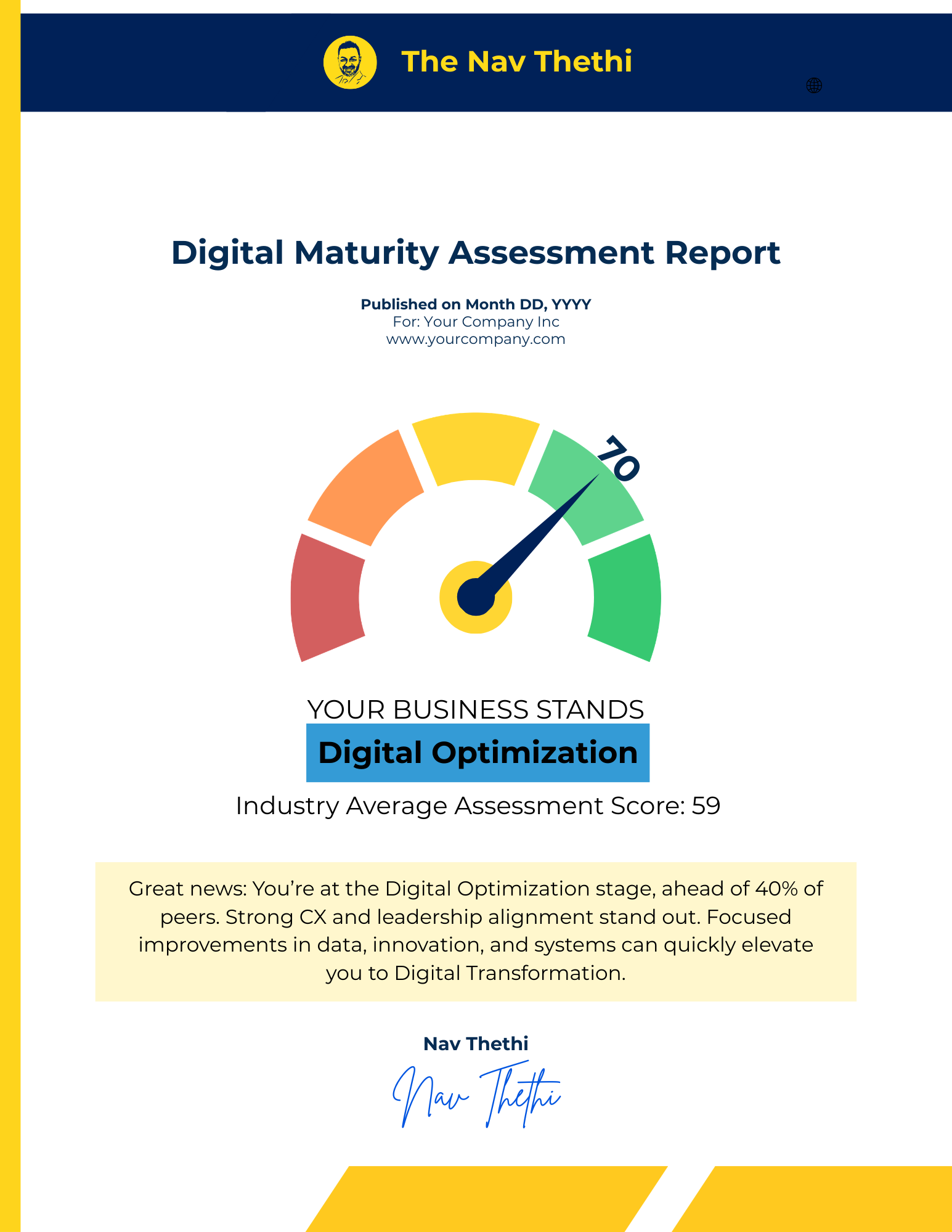
What Does the Ecosystem Maturity Report Reveal?
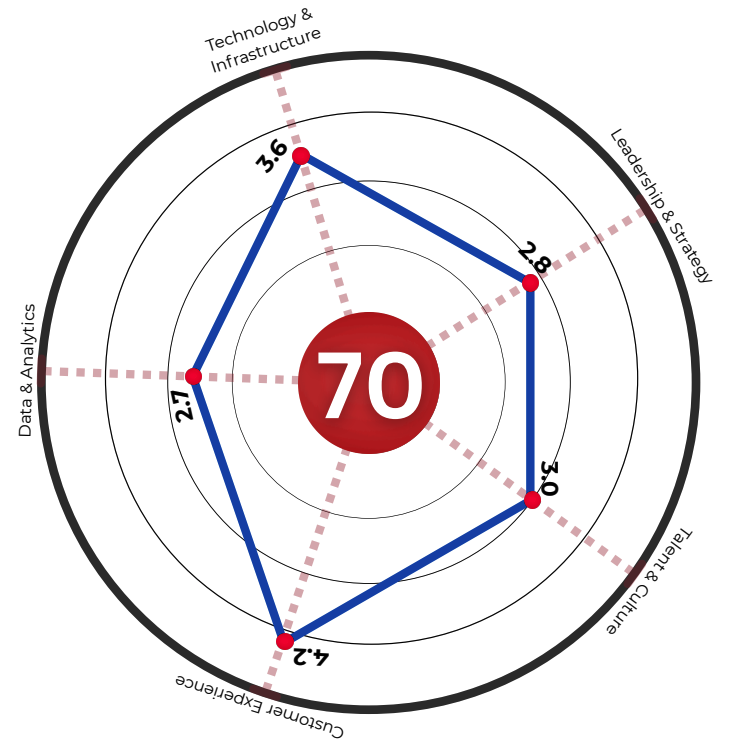
The Digital Maturity Assessment evaluates ecosystem alignment across:
- Technology & Infrastructure
- Data & Analytics
- Customer Experience
- Talent & Culture
- Leadership & Strategy
The report benchmarks your maturity stage, identifies redundancy exposure, integration drift, and governance gaps.
How Optimized Is Your Digital Ecosystem?
Assess how well your platforms, integrations, and governance structures operate as a coordinated system.
Structural Coherence Begins with Measurement
This assessment provides:
- Ecosystem Maturity Score
- Redundancy & Overlap Indicators
- Integration Stability Metrics
- Governance Gaps
- Priority Consolidation Opportunities
Nav helps leaders restructure digital ecosystems so platforms align with how the organization actually operates. The focus is on eliminating systemic friction, improving platform coordination, and designing ecosystems that support both customers and teams. Technology becomes an integrated foundation- not a fragmented stack.
FAQ
Your Questions Answered: Insights for Clarity and Confidence
No.
A tech audit catalogs tools. Ecosystem optimization focuses on how platforms interact to support workflows and outcomes.
Digital transformation focuses on change.
Ecosystem optimization ensures the underlying systems can support that change effectively.
Yes.
The strategy focuses on system design and alignment, not specific technologies.
Not necessarily.
Most organizations can unlock significant value by aligning and integrating what they already have.
Digital maturity determines how well platforms can be coordinated, governed, and scaled across the organization.
Integration decisions are driven by workflow criticality and data dependency, not tool popularity. Optimization focuses on strengthening the integrations that directly impact decision-making, execution speed, and customer experience.