

AI Maturity
Understand how organizations evolve from AI experimentation to enterprise intelligence.
Why AI Maturity Matters
AI adoption is accelerating across industries, yet most organizations struggle to translate experimentation into measurable business value. Research shows that around 60% of organizations remain in the early stages of AI maturity, where initiatives exist but scale and impact remain limited. Only about 15% reach advanced maturity, where AI is integrated into operations and decision-making.
The difference lies in how widely AI is embedded across the organization. In early stages, AI influences less than 10% of core processes. In more mature organizations, AI supports over 60% of operational and decision workflows, enabling measurable gains in efficiency, revenue contribution, and customer experience.
AI maturity explains how organizations move from isolated pilots to enterprise intelligence, where AI becomes a reliable driver of business performance.
Performance Across AI Maturity Stages
This table illustrates how organizational performance evolves as companies progress through the five stages of AI maturity. As maturity increases, AI adoption scales, decision-making becomes data-driven, and value shifts from isolated pilots to predictable enterprise outcomes.
| KPI | Awareness | Experimentation | Integration | Optimization | Transformation |
| AI Adaption at Scale | < 10% | 10-20% | 20-35% | 35-60% | 60% |
| Clear AI Strategy | Rare | Emerging | Partial | Operational | Standard |
| Data-driven Decisions | Sparodic | Functional | Departmental | Cross-Functional | Enterprise-wide |
| AI Revenue Contribution | Minimal | Isolated | Noticeable | Significant | Core |
| Operational Efficiency Gains | Little | Early Wins | Process Improvement | Measured | Optimized |
| Customer Retention/NPS Gains | No measurement Impact | Early signals | Variable | Predictable | Elevated |
| Cross-Functional Adaption | Rare | Pilots | Moderate | Broad | Pervasive |
Sources: BCG | Accenture | Wharton
Organizations in early maturity stages typically struggle with fragmented pilots, unclear strategy, and limited measurable impact. As maturity increases, AI becomes embedded into workflows, decision systems, and customer experiences and transforming isolated initiatives into scalable enterprise capability.
What is AI Maturity?
AI maturity reflects how effectively an organization integrates:
- Data infrastructure
- Machine learning systems
- Decision processes
- Human expertise
to generate continuous intelligence. It is not measured by the number of AI models deployed. It is measured by how reliably intelligence flows into enterprise decisions and operations.
The Five Stages of AI Maturity
AI Awareness: Organizations explore AI capabilities and emerging opportunities.
AI Experimentation: Teams test models and AI tools across isolated use cases.
AI Integration: AI systems begin connecting with operational workflows and enterprise data.
AI Operationalization: AI models support decision processes across business functions.
Enterprise Intelligence: AI becomes embedded into strategic planning, operations, and enterprise performance.

What Higher AI Maturity Enables

Smarter Decisions
AI augments human judgment with predictive insights.

Operational Intelligence
Systems continuously learn from operational data.

Enterprise Automation
Routine processes become intelligent and adaptive.

Strategic Advantage
Organizations respond faster to change and emerging opportunities.

How AI Maturity Connects to Enterprise Strategy
AI maturity strengthens multiple enterprise capabilities.
These include:
Assess Your AI Maturity
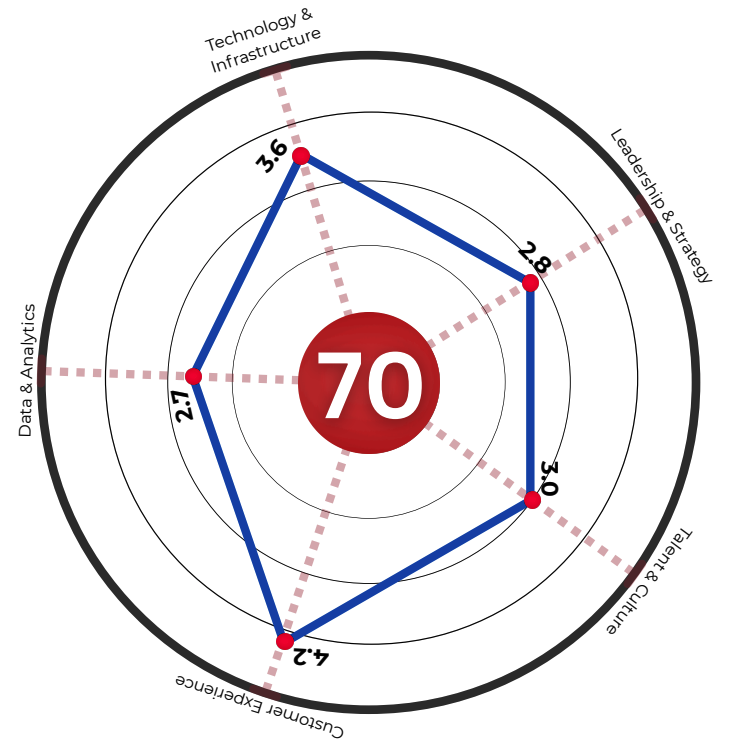
The AI Maturity Assessment evaluates alignment across key dimensions:
- AI infrastructure
- Data readiness
- Governance & risk management
- Talent & organizational capability
- Decision integration
The assessment identifies maturity gaps and priority actions for building enterprise intelligence.
Trusted by top-notch companies







The views and offerings on this website are my own and I do not represent or reflect those of any other brands.
FAQ
Your Questions Answered: Insights for Clarity and Confidence
What is an AI maturity model?
An AI maturity model helps organizations understand how advanced their AI capabilities are across strategy, data, technology, and operations. It shows how companies progress from early experimentation to enterprise wide intelligence that supports decisions and performance.
Can organizations measure AI maturity objectively?
Yes. AI maturity can be assessed using structured frameworks that evaluate areas such as data readiness, governance, technology infrastructure, talent, and leadership alignment.
How does AI maturity affect enterprise strategy?
Higher AI maturity enables organizations to make faster decisions, improve operational efficiency, and create new sources of revenue by embedding intelligence across core business processes.
How is AI maturity different from AI adoption?
AI adoption refers to using AI tools or running pilots. AI maturity reflects how deeply AI is integrated into strategy, workflows, and decision making across the organization.
Why do many AI initiatives fail to scale?
Many initiatives remain pilots because organizations lack clear strategy, integrated data systems, and governance. Without these foundations, AI experiments rarely translate into scalable business outcomes.
What are the stages of AI maturity?
Organizations typically move through stages beginning with awareness and experimentation, followed by integration and operational use, and ultimately reaching enterprise intelligence where AI supports strategy and performance across the business.