

The hero job role in 2026 is going to be The Strategic Integrator, regardless of the function or title.
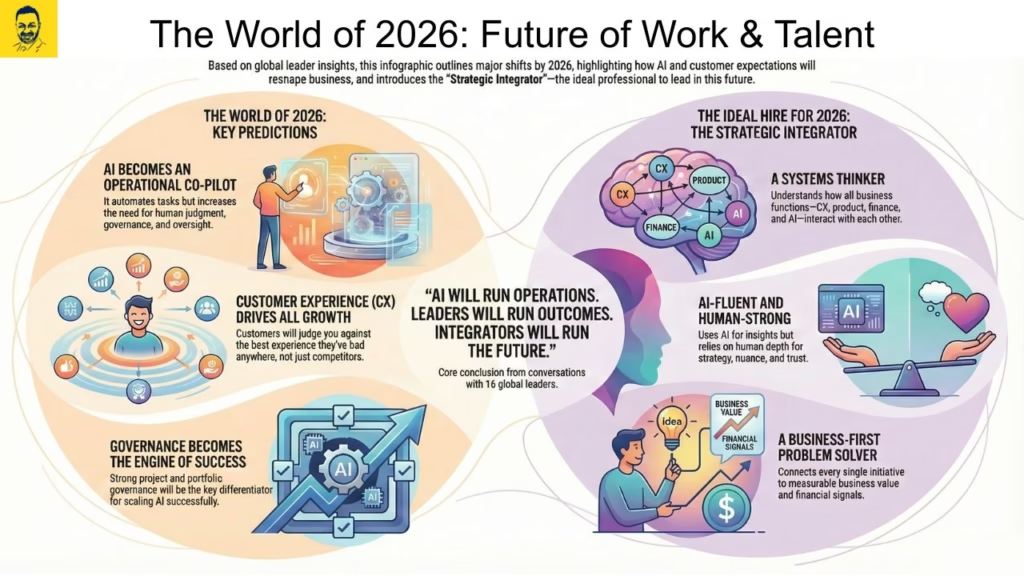
AI is no longer a future worry, it’s a present force reshaping how, where, and what work will look like by 2026. Global leaders on The Nav Thethi Show shared that the future of work will be defined by skills, adaptability, and human‑centered collaboration with AI, not a simple replacement of people by machines.
If you’re a jobseeker feeling anxious about AI, you’re not alone. But the story isn’t doom, it’s about choice and preparation.
Here’s how to proactively align your career pathway with AI trends, stay relevant, and thrive in the future of work.
AI Won’t Just Replace Jobs — It Will Redefine Them
According to global workforce reports, AI and automation are expected to transform billions of work tasks by 2030 displacing some roles, but creating others and reshaping human‑machine collaboration.
Rather than fearing this shift, successful professionals will ask:
“How do I leverage AI to enhance my work, not be replaced by it?”
Most organizations see AI not just as automation, but as a productivity and intelligence amplifier when used responsibly alongside human skills.
Step‑by‑Step Guide to Align Your Career With AI
Below is a clear, actionable roadmap to help you future‑proof your skills and job prospects:
1. Understand What AI Can and Cannot Do
AI excels at:
- Repetitive data tasks
- Pattern recognition
- Generation of first drafts or summaries
But AI doesn’t replace human judgment, creativity, ethics, or context‑aware decision‑making.
That means roles rooted in strategy, complex judgement, empathy, and creative problem solving still matter, and will matter more.
2. Identify Your Core Strengths and Transferable Skills
Ask yourself:
- What do I enjoy doing?
- What tasks do I do better than AI?
- Where do I add context, insight, or human connection?
AI‑proof skills include:
- Critical thinking
- Complex problem solving
- Communication
- Emotional intelligence
- Creativity
These are in high demand as tools like AI automate routine work but still need humans to interpret outcomes.
3. Reskill Using AI‑Augmented Learning Paths
To future‑proof your career, focus on:
A. Digital and AI Literacy
Understanding how AI tools work, what they can generate, and where they fail is a core edge.
Starting point checklist:
- Learn basic AI workflows
- Explore data analytics tools
- Try prompt engineering fundamentals
(Platforms like Coursera, Udemy, LinkedIn Learning offer these)
B. Specialized or Technical Skills
Not everyone needs to code — but learning skills such as:
- Data analysis
- Cloud basics
- AI‑powered marketing tools
- UX design
can boost your employability significantly.
C. Soft Skills That AI Can’t Replace
Empathy, ethics, strategy, facilitation, these are not just “nice to have.” They’re becoming central to work.
4. Get Recognized With Micro‑Certifications
Traditional degrees matter less in an AI economy. Companies are increasingly hiring based on proven skills, not just credentials.
Actions you can take:
- Earn micro‑credentials (AI literacy, project management, digital marketing)
- Add portfolio work that showcases real tasks using AI tools
- Link credentials to your LinkedIn and resume
This approach signals capability, not just theory.
5. Embrace a Portfolio Career, Not a Job Title
In the era of AI, careers will be less about one job title and more about:
- A bundle of valuable skills
- Demonstrated outcomes
- Adaptability over time
Think of your career like a portfolio of abilities, each of which can stand alone or combine with others.
The fundamental hero title in this new AI-era is going to be The Strategic Integrator, who is able to keep delivering value by merging business acuments with technology ecosystem.
Mindset Shift: From Risk to Opportunity
AI is accelerating skill demand, not employment decline — but workers must adapt faster than the technology evolves.
Here’s the upside:
- AI can do routine tasks — freeing humans for strategic, creative work
- Organizations are prioritizing skills‑first hiring, not pedigree
- Soft skills and context understanding remain uniquely human strengths
Your goal as a jobseeker is simple:
Move toward work that requires contextual judgment + AI collaboration
Learn how to write effective prompts and use them to save time, enhance creativity, and extract maximum value from every tool you touch.
“In the age of AI, those who master prompting will lead, not follow.”
Start here:
- OpenAI Playground — the best place to test prompts live (GPT‑4 & beyond).
- Hugging Face Inference UI — try prompts on multiple models.
- PromptBase — marketplace to see how elite prompts are structured (and buy templates).
Four Career Paths That Will Grow Through 2026
- AI‑Augmented Analysis: Leverage AI to generate insights, then apply human judgment to interpret data and drive decisions; combine data analytics skills with industry expertise.
- Customer Experience & Strategy: Use AI to enhance personalization and efficiency while relying on empathy, communication, and strategic thinking to design high-impact customer journeys.
- Creative & Design Work: Blend AI-assisted tools with human imagination and storytelling; success comes from portfolios that showcase conceptual thinking powered by smart technology.
- Project/Program Management: Guide hybrid teams where AI tracks tasks but humans align strategy, resolve issues, and deliver outcomes; future-proof with PM certification and AI literacy.
“According to the U.S. Bureau of Labor Statistics, employment for project management specialists is projected to grow 7% through 2032 — faster than the average for all occupations.”
Final Words
AI doesn’t have to mean job loss — it can mean a career upgrade.
By:
- Understanding AI’s limits
- Building hybrid human‑AI skills
- Earning digital credentials
- Focusing on high‑value work
…you position yourself not just for survival, but for advantage.
And remember — one of the most consistent insights from global leaders is that the future of work won’t be shaped by machines alone, but by humans who best collaborate with them.
That’s your opportunity.
Follow my LinkedIn page for continuous learning.