

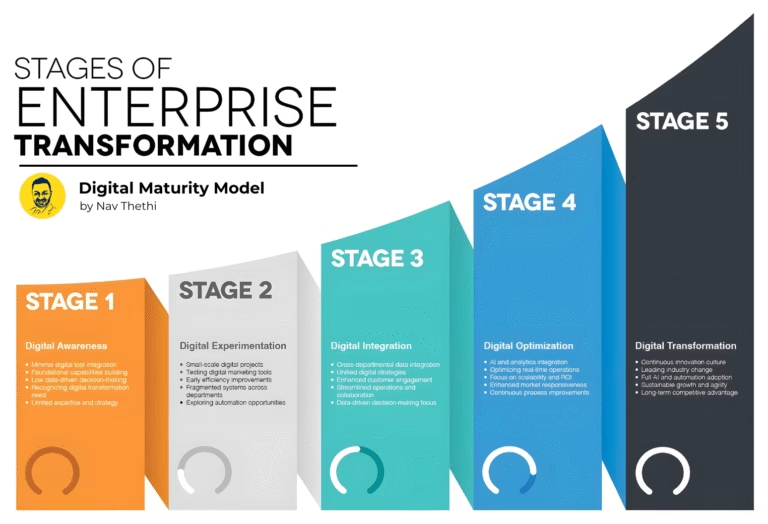
Why Most Transformations Stall at Stage 2
After dozens of conversations with global digital leaders, a pattern has emerged. Most organizations aren’t failing because they lack the “right” technology; they are failing because they are treating digital growth as a shopping list rather than a maturity journey. They are “buying the fabric” of the future while their current operations are still trapped in a messy Digital Closet.
Here are the five most consistent messages from the front lines of digital transformation:
1. The Mono-Industry Tunnel Vision
Most leaders define success by looking at their immediate neighbors. They benchmark against direct competitors and, in doing so, inherit the same limitations and blind spots as everyone else in their sector.
- The Radical Truth: If you only look at your own industry, you aren’t innovating; you’re just decorating a narrow tunnel.
- The Supporting Voice: Kerry Chrapliwy notes, “Most people lead from a mono-industry perspective… they focus only on the competitors in that industry. Pretty soon you’re going down a very narrow tunnel… I always try to be poly-industry and look across multiple industries. That’s where real innovation happens.”
2. The Infrastructure-as-CX Fallacy
There is a massive gap between the “Brand Promise” (what marketing says) and the “Operational Reality” (what the tech can actually do). Many leaders treat Customer Experience as a coat of paint, forgetting that the “plumbing” determines the outcome.
- The Radical Truth: Your customer experience is only as strong as your back-end integration.
- The Supporting Voice: Tabitha Dunn emphasizes, “If you don’t have the right foundation, you’re just making the wrong things happen faster. The customer doesn’t care about your internal silos… when it doesn’t work, that trust is gone.” Tue Sottrup adds, “A lot of companies focus on the ‘Wow’ effect at the front end, but they forget the ‘How’ at the back end.”
3. The “Data Rich, Insight Poor” Trap
Enterprises are obsessed with collecting data, but they lack a “Unified Data Backbone.” This creates a “Digital Closet” full of noisy, untrusted information that acts as a financial liability rather than an asset.
- The Radical Truth: Storing data is a cost; using data is an investment.
- The Supporting Voice: Mike Foley observes, “Most companies have more data than they know what to do with, but they don’t have a ‘Unified Data Backbone.’ They have pockets of information that don’t talk to each other.” Bill Schmarzo reinforces this, saying, “Data is the only asset that never wears out… yet, most companies treat it like a disposal cost.”
4. Technical Debt as a “Complexity Tax”
Digital Economics is often ignored until the bill comes due. Organizations keep adding new “shiny objects” without decommissioning the old ones, leading to a graveyard of “Zombie Assets” that drain the budget.
- The Radical Truth: Complexity is a cost; simplicity is a financial strategy.
- The Supporting Voice: Germain St-Denis warns, “Most leaders look at the top-line ‘spend’ on technology, but they ignore the ‘Digital Friction’ cost. When your systems don’t talk to each other, you are paying a hidden tax on every single transaction.” Hari Pudipeddi notes that we must shift from technical milestones to “Value Realization.”
5. Efficiency is the Only Path to Sustainability
Sustainability is often treated as a PR exercise, but in a matured enterprise, it is the ultimate measure of operational excellence. Waste—whether it’s carbon, “Dark Data,” or redundant servers—is a sign of low maturity.
- The Radical Truth: If you aren’t green, you aren’t matured.
- The Supporting Voice: Justin Bean points out, “Most companies treat sustainability as a compliance burden… the same digital maturity required to optimize a supply chain is exactly what is needed to eliminate carbon waste. If you have a messy digital closet, you are literally burning money and the planet at the same time.”
3 Big Take-Away Action Plans
To move your organization from a state of “Digital Hoarding” to “Future-Ready Yield,” prioritize these three actions:
- Audit the Digital Closet: Before buying any new “fabric” or AI tools, perform a ruthless audit of your current stack. Identify “Zombie Assets” and redundant data silos. If a tool doesn’t contribute to the Unified Data Backbone, it is a candidate for decommissioning.
- Adopt a Poly-Industry Lens: Assign your strategy teams to benchmark outside your sector. Look at how fashion handles “Emotional Currency,” how entertainment handles “Engagement,” or how logistics handles “Friction.” Use these cross-sector inspirations to break out of the mono-industry tunnel.
- Bridge the Alignment Gap: Move the conversation from IT “Spend” to Digital Economics. Every technical investment must be linked to a specific business outcome—whether that is reducing the “Customer Effort Score” or increasing “Operational Yield.” If you can’t measure the realization of value, don’t greenlight the project.
NOTE: All these conversations are recorded and will be published on our podcast channels soon.
Subscribe for early access: https://www.linkedin.com/company/thenavthethi/